
ABOUT UGANDA
Uganda is the pearl of Africa with fantastic natural scenery and a rich mosaic of tribes and cultures. Traveling through Uganda you will be captivated by its beauty, overwhelmed by the friendliness of its people and intrigued by all that Uganda has to offer.
Location: Uganda lies astride the Equator in Eastern Africa. We are bordered by the Republic of South Sudan to the North, The Republic of Congo to the west, and The Republic of Tanzania and the Republic of Rwanda to the south.
SAFARIS
Bwindi Impenetrable Forest Gorilla Tracking Safari - 4 Days
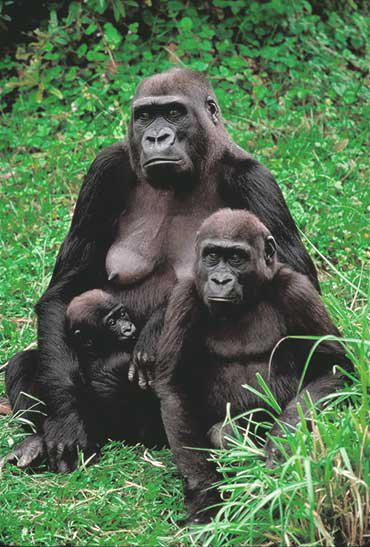
This fascinating trip will take you Bwindi Impenetrable Forest for mountain gorilla tracking and Queen Elizabeth National Park where you will enjoy game drives in search of different animal species. Gorillas of Bwindi Impenetrable Forest plus wildlife of the Queen Elizabeth NP and a boat ride that will expose to you various bird and animal species are among the most amazing attractions that one must not miss on a trip to Uganda.

BWINDI IMPENETRABLE & QUEEN ELIZABETH NATIONAL PARK:
Day 1:
Drive to Bwindi Impenetrable Gorilla Forest. Tours and Travel guide will pick you in the morning after breakfast, then depart from Kampala by road and head South-West to Bwindi Impenetrable National Park. Have a break in your journey for some enlightening interaction and pictographic break at the Uganda Equator before continuing to Mbarara Town where you have a lunch break. You will the drive straight to Bwindi Impenetrable Forest, a habitat for the Uganda Mountain Gorillas and you will relax to the charms of the mountain rainforest. Overnight at Gorilla Resort or Buhoma community Bandas.
Day 2:
Gorilla Trekking in Bwindi Impenetrable Gorilla Forest In the morning, have enough breakfast to gain power necessary for gorillas tracking during which a reliable scale of strength is crucial for the exercise. Before 8:00am, report to the ranger station for registration and briefing by one of the ranger guides. You will trek through chunky creepers and bushes with your guides to look for the Mountain Gorillas, an exercise that could last between 1 to 9 hours. It is amazing to sit in the forest among the gorillas, paying attention to them protest to each other. It is an unusual mood being with these stunning human-like animals. Time allowed with these primates is only 1 hour in which every minute counts much. With a free afternoon at your disposal, you can alternatively take a guided stride out on the Munyaga River trail that leads to three pleasant shining waterfalls with views of epiphytic ferns, tree ferns, orchid’s colorful butterflies or have a guided village hike to see how the locals use up their lives. Overnight at Gorilla Resort, Buhoma Community Bandas .
Day 3:
Queen Elizabeth National Park, Take breakfast and head off in the early hours to Queen Elizabeth National Park through the as Ishasha Sector, the southern isolated and fine-looking section of Queen Elizabeth National Park, famous for its tree-climbing lions. It is stunning to see the lions enfold from the trees and you will also see hippos, buffalos and topis among others. Check-in in your hotel to have some time for relation at the lodge. Overnight at Mweya safari Lodge, Mweya Hostel of Institute of Ecology or another depending on your package.
Day 4:
Short Game Drive and Drive to Kampala Take breakfast and start your come back journey to Kampala taking a game drive to spot elephants, warthogs, waterbucks, hippos and others on your way out. Have lunch en-route in Mbarara town or Masaka and reach Kampala in the late afternoon.
Murchison Falls Nature and Wildlife Trip;
3 Days
Murchison Falls National Park is the largest park in Uganda measuring about 3,840 square kilometers. It is a home to the large African wild animals including buffalos, elephants, Crocodiles, Lions, Leopards, Hippopotamuses, Antelopes, Giraffes, Uganda Kobs, Oribis to mention and numerous bird species. Another best moment is at the top of the falls and a boat ride on the calm River... Read more Murchison Falls National Park - 3 Days Murchison Falls National Park is the largest national park in Uganda measuring about 3,840 square kilometers (1,480 sq mi). The park is a portion of the 5,308 square kilometers (2,049 sq mi) that make up the Murchison Falls Conservation Area (MFCA). Murchison Falls National Park is situated in Masindi District in western Uganda and in Amuru in northern Uganda. The park is a territory to the large African wild animals including Water buffalo, elephant, Crocodile, Lion, Leopard, Hippopotamus, Antelope, Giraffes, Uganda Kob, Oribi and other animals plus a number of bird species. River Nile crossing the park is a home to selection of water birds, including the amazing Shoe bill stork.

UGANDA SAFARI TO MURCHISON FALLS NATIONAL PARK.
DAY 01:
Drive to Murchison Falls National Park From Kampala, head to Murchison Falls National Park going through Luwero, Nakasongola and Masindi district. The trip will provide you with vast mesmerizing view before you arrive at the park in the afternoon. Drive to the top of the falls where the Nile wonderfully demonstrates its splendor. At this spot, you will see the peaceful River Nile waters dropping through a slim gap to go down about 150 feet mixing up to create white water with a loud roar, a hard to believe scene! Cross over the Nile by ferry for dinner and overnight at Paraa Safari Lodge or another depending on your package.
DAY 02:
Game Drive Tour, Launch Cruise At sunrise, have breakfast and start the morning game drive to have a glimpse of the early risers. This thrilling game drive will bring animals like the jackals, hyenas, giraffes, lions, antelopes, elephants and the Uganda kob among others to your sight. You will take a break from the game drive for something to eat and soon after have your lunch. In the afternoon, you will go for an open launch cruise. This boat cruise will take you to the bottom of the falls where animals like the buffaloes, hippos, crocodiles, elephants and an abundance of water birds like fish eagles, the exceptional shoebills and many more will be seen. Retreat for overnight and dinner hotel of your choice d epending on your package.
 .
.
DAY 3:
Chimpanzee Trekking in Budongo (Optional) and drive to Kampala Take an early expedition to Budongo Forest. You will go for an early morning walk in this vast forest where you will get to see a wider range of primates and chimpanzees. This forest has one of the highest primate concentrations in the whole world. You will see families of chimpanzees, baboons, colobus monkeys and other primates jumping without restraint in the forest tree branches. Move back to the lodge for a rest. Have Lunch and head back to Kampala where you will arrive in the evening.
Rwenzori Mountaineering Adventure ;
9 Days
Rwenzori Mountain is the highest mountain range in Africa with 6 snow–capped peaks and 3 glaciers. Climbing to the peak of such Africa’s outstanding physical feature is a memorable and rare experience by any living person. You can enjoy short hikes for a few days or a complete hike to Magherita peak for seven days. Climbing Rwenzori is an adventure one should undertake as a lifetime experience.
9 Days RWENZORI MOUNTAINEERING
Day 1:
Transfer from Kampala to Queen Elizabeth National Park. After breakfast, drive off to Kasese via Masaka, Mbarara, Bushenyi going through Queen Elizabeth National Park. Make a stopover at Mpambire in Mpigi for traditional handicrafts. Stop at the Uganda Equator, a point for the imaginary line believed to be dividing the world into two hemispheres (Northern and Southern Hemisphere). Have lunch in Mbarara town before continuing to Rwenzori Mountain. Dinner and overnight in Kasese Town.
Day 2:
Nyakalengija Trailhead (1600m). After breakfast, initiate you initiate your mountaineering exercise by hiking to the Nyabitaba hut and shortly connect to Nyakalengija trailhead (1600m) with tour guides and porters climbing up to Nyabitaba hut going through the homesteads and the local plantations which is a amazing experience. Then follow the trail along the Mubuku River, via the landslides up and down rocks and bluffs. Walk across the Mahoma River and ascend steeply through the bracken fern slopes and Podocarpus forest to Nyabitaba Hut for an Overnight.
Day 3:
Nyakalengija Trailhead - John Matte Hut (3350m) From Nyabitaba hut, follow the trail which drops you down through the woodland to the Kurt Shafer Bridge, just below the meeting point of the Bujuku and Mubuku Rivers. Ascend via the bamboo forest, going across a long and a strenuous stretch of slippery moss-covered rock. From Nyamileju rock shelter, on clear-sight days, Mount Stanley and Mount Speke can be seen before passing into the zone of the giant heather, lobelia and groundsel. The final stretch to the John Matte hut is across a strenuous marshland, the first of many for which the mountain is well-known. Overnight at John Matte Hut .
Day 4:
John Matte Hut - Bujuku Hut (3900m) After John Matte Hut, the trail goes downhill to cross River Bujuku and enters Lower Bigo Bog, home of giant lobelias. Jumping a tussock after the other, the bog is crossed but at times the feet taste the glacial ooze. The Upper Bigo bog gives a way to Bujuku Lake, with the sight of Mt. Baker to the South and Mt Stanley to the West. Bujuku Hut, suitably positioned in the shadow of Mount Baker and Mount Speke, is in a narrow valley below Stuhlmann Pass. Be prepared for this trail which can be very cold for you as well as to the dwellers of Rwenzori. Overnight at Bujuku Hut.
Day 5:
Bujuku Hut - Elena Hut (4541) From Bujuku, via more bog, the trail ascends the slopes west of the lake, passing through the magical Groundsel Gully as it goes up to Scott-Elliot Pass at 4372m. A metal ladder takes you over a steep section after which the trail splits into two at the head of the channel. The right path goes up to Elena Hut and Mount Stanley on a steep trail over large boulders whereas the left path leads to Scott-Elliot Pass and down to Kitandara Lakes. Overnight at Elena Hut, though the nights may be cool..

Day 6:
Elena Hut - Margherita Peak (5109m) Hiking Margherita peak (5109m) to the base of the Stanley Glacier continues. Basing on the weather and one’s area familiarity, it can be a walk of between 4 to 7 hours to the pinnacle of Margherita. It is a hard walk over three glaciers, slippery rock, ice and very open on many sides. The physically fit are the only ones for this and it is a technical climb which needs roping up, crampons and proper equipment for cold, windy and icy conditions. It is good to try the final climb in a group of at least four-two climbers and 2 guides; (the extra guide has to be paid for at the time of booking). Climb on to the glacier, cross the Stanley Plateau and move on with the rise. Basing on altitude sickness, fog and weather, push up to the summit of Margherita, the Rwenzori peak. It is not guaranteed that everyone will reach the summit because of the altitude and the tough conditions. So do not get disappointed if you do not make it. Coming back to Scott-Elliot pass, you get magnificent views back to Bujuku Lake and Mount Speke, up to Mount Stanley and down to the Kitandara Lakes. Once over the pass the trail enters an alpine zone of sparse vegetation and rough boulders. Go down to Kitandara Hut for overnight, past the Kitandara Lakes. (If you do not wish to climb the peak, a more restful day walking from Elena Hut to Kitandara Hut 4,023m.)
Day 7: Guy Yeoman Hut (3260m) After Kitandara, the trail goes up sharply to the head wall, spreading out from the Mount Baker base and proceeds to the south side of the mountain to Fresh field Pass. On a good day, you see part of the Congo in the west and Mount Stanley in the north. From the pass, the long mud-spattered trail goes down, going through the rock shelter at Bujongolo, this is the base camp for the historic expedition by the Duke of Abuzz in 1906 .
Day 8:
Nyabitaba Hut (2650m) This hike will lead you through the path down but can be slippery and muddy with little to hold on. Thus, you must be careful balancing over the vertical mud or steep rocks. Overnight at Nyabitaba Hut .
Day 9:
Nyakalengija Trail head (1600m) – Back to Kampala From Nyabitaba hut, move down gently to the muddy paths to the trail head. Arrive late morning, head to Kasese for lunch and then drive to Kampala where you will arrive in the
evening.

LAKE BUNYONYI
Lake Bunyonyi is found in South Western Uganda between Kisoro and Kabale near the Rwandan border and it is positioned 450 Km from Kampala. It is a drive of 7 hours from Kampala and a drive of 100 km (2 hours) from Kigali, the capital city of Rwanda. Located at 1,962 meters above the sea level, the 25 km long and 7 km wide lake covering an area of 61 square kilometers is believed to be the deepest lake in Africa with varying length of between 44 m to 900 meters. The lake surface is a fresh with 25 degrees celicious thus bilhazia free and safe for swimming. The lake has 29 islands that include Punishment Island and Bushara Island which are all concentrated in the central part. This water body is known for the surrounding terraced hillsides and is a visitation darling of many foreign and domestic tourists with a number of accommodations. Located seven kilometers west from Kabale Town, southwestern Uganda, Bunyonyi is surrounded by hills that are 2,200 to 2,478 meters high and intensely cultivated. In the beginning of the 20th century, fish were introduced to the lake and in the 1930s fishing became profitable. Unfortunately in the 1960s the fish died massively as a result of a violent shallow mixing, likely caused by wind. Subsistence fishing prevailed in the lake, people mostly caught cl arias species - the lake's depth and stratification makes it difficult for the breeding of the common Ugandan species Nile Perch and Tilapia. Nevertheless, 300,000 Nile Tilapias and Clarias fish were released in the lake at the end of 2002. Also present in the lake are Mud fish, Cray fish and Mirrowcarp plus a plenty of their predators, otters.
About 200 bird species have been recorded at the lake area since "Bunyonyi" also means "the place of many little birds". The bird species include the White tailed Blue Mona rd, grey crowned cranes, the African Harrier Hawk, Herons and egrets, the Levillant cuckoo, the Cardinal Woodpecker and the Rufus-breasted wry-neck. Weavers nesting on the Island, include the large golden, slender-billed Baglafetch, as well as the yellow-backed and spectacle d weavers. The lake's main center is Bufuka Village. The area's inhabitants are from the Bakiga and the Batwa tribes.
Lake Bunyonyi Main islands
1. Bushara Island.
This island is also a place for Lake Bunyonyi Development Company, an organization with strong links to Church of Uganda. Tourism is the main source of funds for various developments around Bunyonyi areas. This island has many luxury tents, chalets, and also campsites for tourists to stay on. You can also hire canoes and sailboats to sail around the lake and its other islands. The island is forested with mainly eucalyptus trees that grow fast.
2. Akampene Punishment Island.
The Bakiga used to leave unmarried pregnant girls on this small island with a tree to die of hunger or die while trying to swim to the mainland as swimming skills were rare. This was to educate the rest, to show them not to do the same. A man without cows to pay the bride wealth could go to the island and get a girl. In the first half of the 20th century, the practice got abandoned but is still possible to find women who were picked up from Punishment Island today.
3. Bwama and Njuyeera (Sharp's Island).
Around 1921, an English missionary, Dr. Leonard Sharp visited this place and established a leprosy treatment center on the then uninhabited Bwama island in 1931. A church, patient quarters and a medical facility were built, while Sharp settled on Njuyeera Island meaning 'white cottage', after the similarity of the doctor's small white house to Sharp's father's house in Shanklin, now The White House Hotel. The rationale of the leprosy colony was that of 'voluntary segregation', where the provision of a happy community to live in would attract leprosy sufferers, so removing them from the communities where they might infect others. The hospital buildings are used by a boarding secondary school which attracts students from the entire region and there is a primary school but no village on the island.
4. Bucuranuka Island. This island, according to legendary stories killed many people. About twenty were once brewing local sorghum beer there. An old woman was passing by and she said: "Can you give me some local beer?" They wrongly though that she was a beggar they knew. They refused her: "Get lost, beggar! Get lost! The old woman asked: "So you will not even give me a sip? Can I at least get somebody to take me to the mainland?" They answered: "Yes, because we are fed up with you!" They chose a young guy to take her over. When they reached the shore and the guy was just beginning to return, the island turned upside down and they all perished but only a chicken flew away and survived.
LAKE BUNYONYI UGANDA TOUR ACTIVITIES.
Safari activities at Bunyonyi include canoeing, boat riding, local tour, swimming, hiking the highlands around the lake, pygmy village tour and birding.Tours and Travel will take you to Lake Bunyonyi Safaris to enjoy and experience the unique gifts of nature.
Nature walks; Walking around the lake Bunyonyi’s waters while listening to bird songs and the tearing water and consequently the feeling of the fresh breeze of Lake Bunyonyi and community around.
Bird watching; This is a key activity and a majority of bird species can be noticed, there are more than 200 species of birds recorded. Using a boat ride to the neighboring Nyombi swamp one is able to see a selection of bird species over the trees and the sky.
Swimming; The waters of Lake Bunyonyi are free from the hazards of bilhazia, dangers of crocodiles, hippos and other threatening animals thus do not miss swimming opportunity. There are swimming spots with swimming docks on some islands of the lake.
Boat cruise and canoeing can also be enjoyed around the lake. This will help you experience the quietness, calmness and the tranquility of Lake Bunyonyi. A canoe ride at night is thrilling given the loud chorus of crickets, frogs, nocturnal birds singing plus the waving lake waters which all make the ride exceedingly exciting.
Historic and cultural tours;
There are attractive cultural and natural sights like the Bakora cave, the Batwa [pygmies] and the Abaheesi [traditional black smiths] communities that are accessible in close proximity. Also visiting islands around the lake like Habuharo, Akempene and Bucuraniko Island is a memory-catching experience.
Visiting pygmies;
Take a boat trip to the local communities of the Batwa/pygmies who live in the islands near the lake and see their ways of life, activities and their charming cultural dance performances. Mountain climbing/biking; Family unit or group picnics and relaxation can also be enjoyed on the islands in the areas of Lake Bunyonyi.
ACCESS TO LAKE BUNYONYI
Lake Bunyonyi is in the neighborhoods of Kabale town in South Western Uganda. On the road, it is 6 hours from Kampala (410 km) to Kabale town and 8 km marrum road from Kabale town to Lake Bunyonyi on your way to Bwindi Forest in Kabale or Mgahinga Gorilla home Kisoro district. Lake Bunyonyi is tangled between the hills of Kabale.
84 ISLANDS ON LAKE VICTORIA;
Uganda has numerous Islands all of which offer great sightseeing, exploration, rambling and sporting opportunities. They include; notably, Ngamba, Ssese Islands- which are cluster Islands, some of which are Bukasa, Buggala, Bufumira, Bukasa, Bubeke and Kkome. Ssese Islands They are a group of 84 islands found on lake Victoria, off the western shore. They are increasingly popular and offer a lot from relaxation since they are not overrun with visitors, insights of the lives of the people known as Basese who are primarily fishermen and farmers. Rambling is the best way to see the islands and boat rides which the fishermen can be talked into. Buggala Island Is the largest Island in the Victorian waters and the best developed for tourism and regularly receives visitors.
Kalangala Island;
The administrative center for the islands and is on the eastern end of the Islands. There are animals and birds on the island the most common being the vervet monkey. Bush buck and black and white colobus are also there. Water and forest birds include varieties of horn bills, turacos, barbets, flycatchers, robin-chats besides others. The nearby Lutoboka Bay hosts the islands cluster of resort beaches and offers a variety of beach activities.
Bukasa Island is the second largest on Lake Victoria and it is very attractive. It is mostly forested and monkeys and birds are plentiful. Points of interest are a plunge pool surrounded by forest and a waterfall. The island can be explored on foot.
Other Islands;
There are many more other islands that form the Ssese Islands, and are worth exploring. Bufumira and Banda and the other smaller and uninhabited ones can all be reached from Buggala aboard fishing boats. Ngamba Island Ngamba is found on Lake Victoria. It is 23km from Entebbe town and is popular because of the chimpanzees it offers sanctuary to. Nicknamed ‘Chimp Island’ because of the Chimpanzee Sanctuary, it is forested and the chimps freely wander about. The chimps at Ngamba tolerate human presence and do not scamper off. They therefore can be viewed at very close range especially during feeding times.
GOD BLESS YOU.
